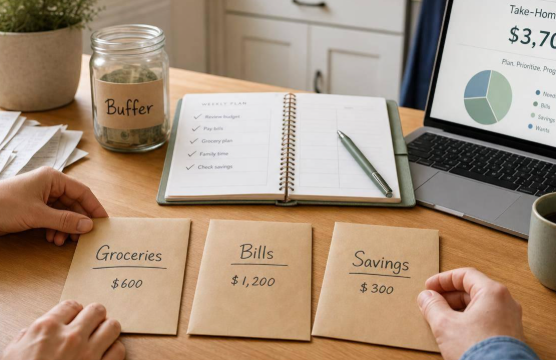
Creating a budget sounds simple: write down what you earn, list your expenses, and make sure the numbers balance.
Yet many people find that their budgets work for a few weeks before becoming difficult to maintain.
The problem is often not a lack of discipline.
It is that the budget does not reflect how real life works.
A useful budget should help you understand your money, prepare for regular expenses, and make everyday spending decisions with less stress. It should be practical enough to follow during an ordinary month, while also giving you room to adjust when circumstances change.
Start With Your Real Income
The first step is to determine how much money you actually have available each month. If you receive a regular salary, use your take-home pay rather than your gross income. Take-home pay is the amount that reaches your bank account after taxes and other deductions.
If your income changes from month to month, budgeting requires a little more planning. Review your income from several recent months and identify a reasonable baseline rather than assuming you will always have your highest-earning month.
Keeping your income estimate realistic gives your budget a stronger foundation. It also reduces the temptation to plan future spending around money that may not arrive.
Understand Where Your Money Goes
Before deciding where your money should go, spend some time looking at where it currently goes.
Review your recent bank statements, receipts, and payment records. Group expenses into broad categories such as housing, groceries, transportation, utilities, subscriptions, entertainment, personal purchases, savings, and debt payments.
Do not worry about making every category perfect. The purpose of this exercise is to identify patterns.
You may discover that a few small purchases are adding up, or that certain expenses occur less frequently than you remembered. You might also find that some costs are essential while others are simply choices that can be adjusted.
Knowing the difference is important because a realistic budget should not treat every expense as equally flexible.
Separate Fixed and Flexible Expenses
Fixed expenses generally stay similar from month to month. Rent, loan payments, insurance premiums, and certain subscriptions may fall into this category.
Flexible expenses can change depending on your choices or circumstances. Groceries, dining out, entertainment, clothing, and some transportation costs are common examples.
Separating these expenses makes your budget easier to manage. Fixed costs tell you how much of your income is already committed, while flexible categories show where you have more control.
However, remember that an expense does not have to be completely fixed or completely flexible. Your grocery bill, for example, may vary each month even though food is an essential expense.
Give Every Part of Your Income a Purpose
Once you understand your income and expenses, create a plan for the money that remains after essential costs.
You might assign part of it to savings, upcoming expenses, debt repayment, hobbies, family activities, or other personal priorities.
The exact percentages do not need to follow a universal formula. A budget that works for one household may not work for another. Housing costs, family responsibilities, income levels, location, and financial goals can all be different.
The goal is to create a plan that reflects your actual circumstances.
Plan for Expenses That Do Not Happen Every Month
One of the most common reasons budgets fail is that they focus only on monthly bills.
Annual insurance payments, school expenses, holidays, home maintenance, vehicle repairs, gifts, and other occasional costs can create significant pressure when they arrive unexpectedly.
Instead of treating these expenses as surprises, make them part of your regular plan.
If you know an expense is likely to occur later in the year, estimate the amount and divide it across the months leading up to it. Setting aside a smaller amount regularly can make a future bill easier to handle.
This approach also helps you distinguish between a genuine emergency and a predictable expense that simply does not happen every month.
Build Some Flexibility Into the Plan
A budget should not require you to predict every purchase perfectly.
Unexpected costs happen. Plans change. A friend may invite you to dinner, transportation costs may increase, or you may need to replace something important.
Consider leaving a small amount of your monthly income unassigned. This creates breathing room for reasonable changes without forcing you to rebuild the entire budget.
Flexibility can also make a budget easier to maintain psychologically. If every dollar is assigned so tightly that one small change makes the plan fail, the system may be too restrictive for everyday life.
Make Savings Part of the Budget
Saving is easier when it is treated as a planned expense rather than whatever happens to remain at the end of the month.
Choose a realistic amount based on your current circumstances. Even a modest contribution can help you develop a consistent saving habit.
You can create separate goals for different purposes, such as an emergency fund, a future purchase, education, travel, or another long-term objective.
If your employer or bank offers automatic transfers, you may be able to schedule money to move into a savings account after you receive your income. Automation can reduce the number of decisions you need to make each month.
Review the Budget Regularly
A budget is not a contract that can never change. It is a planning tool.
Set aside a few minutes at the end of each month to compare your plan with your actual spending. Look for meaningful differences rather than criticizing yourself over every small variation.
If groceries consistently cost more than expected, adjust the category. If a subscription is rarely used, consider whether it still belongs in your plan. If your income changes, update the budget accordingly.
This review process turns budgeting into a continuous learning exercise.
Avoid Making the Budget Too Complicated
A complicated system may look impressive but can become difficult to maintain.
You can start with a simple spreadsheet, notebook, banking app, or budgeting application. What matters most is that you understand the system and can update it without spending excessive time on it.
For many people, a handful of clear categories is enough to begin. You can always make the system more detailed later if you discover that additional information would help you make better decisions.
Give Yourself Time to Improve
A successful budget rarely appears fully formed on the first attempt.
Your first version is an estimate. After a few months, you will have better information about your spending patterns, irregular expenses, and realistic savings capacity.
Instead of abandoning the process when something does not work, treat the experience as useful feedback.
The best budget is not necessarily the strictest one. It is the one you can understand, maintain, and adjust while still helping you use your money intentionally.
Final Thoughts
Building a budget that actually works is less about restricting every purchase and more about creating a clear picture of your financial life.
Start with realistic income, understand your spending, separate fixed and flexible costs, prepare for irregular expenses, include savings, and leave enough flexibility for normal life. Then review the plan regularly and make adjustments as your circumstances change.
A practical budget should give you information and structure without making everyday money decisions unnecessarily complicated. Once the system reflects your real life, managing your money can become a routine rather than a constant source of frustration.